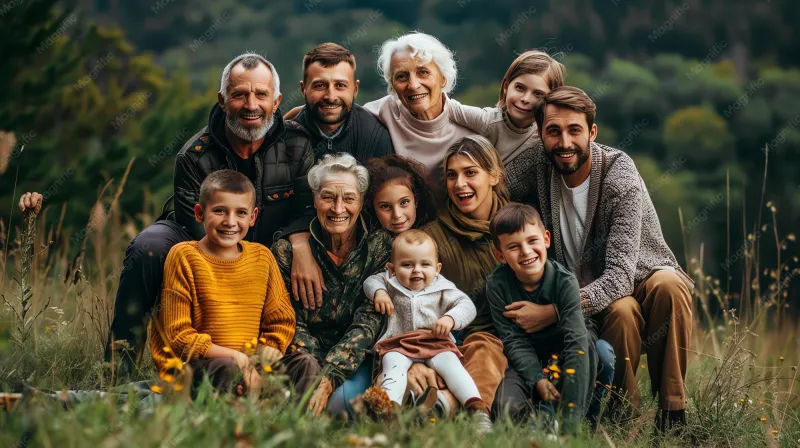
Before the Stories Disappear: A Family's Guide to Capturing the Voices, Memories, and Moments That Matter Most
Somewhere in your family tree, there's a story nobody has written down. Maybe it's the one your grandmother tells every Thanksgiving about arriving in America with forty dollars and a suitcase. Maybe it's the way your grandfather describes the summer he worked on a fishing boat in Alaska at seventeen. Maybe it's something smaller—a recipe that came from a place that no longer exists, or a nickname whose origin nobody can quite remember anymore.
These stories are irreplaceable. And most of them are in serious danger of being lost.
Not because families don't care. But because life is busy, the moment never feels quite right, and somehow we keep assuming there will be more time.
There might not be. But the good news is, starting is easier than you think.
Why This Matters More Than You Realize
Researchers who study family dynamics have found something striking: children and teenagers who know their family's stories—the struggles, the triumphs, the weird detours—tend to have stronger senses of identity and resilience. Knowing where you come from gives you a kind of emotional anchor when life gets choppy.
For older generations, the act of telling those stories has its own rewards. Being listened to, really listened to, is validating in a way that few other experiences match. It communicates that a life was worth paying attention to. That matters enormously.
And for the whole family? The process of gathering these stories has a way of revealing connections nobody expected. Cousins discover shared fears. Grandchildren realize they inherited not just their grandmother's eyes but her stubbornness. Uncles learn things about their own parents they never thought to ask about.
Start With a Single Conversation
The biggest mistake families make is waiting until they have a plan. Don't wait for a plan. Start with a single question at your next family gathering.
Some prompts that tend to open things up:
- "What's the earliest memory you can still picture clearly?"
- "What was the hardest year of your life, and how did you get through it?"
- "Is there something you wish you'd done differently?"
- "What do you want us to remember about you?"
That last one, gentle as it is, tends to stop people in their tracks—in the best way. It gives elders permission to be intentional about their legacy. And it gives younger family members a window into something real.
You don't need to turn it into an interview. Let it be a conversation. Follow the threads that feel interesting. Be comfortable with silence.
The Tools You Already Have
You don't need fancy equipment. Your smartphone is genuinely all you need to start.
Voice memos are underrated and underused. They capture tone, pauses, laughter—the stuff that a transcript can never fully convey. Hit record before a meal and just let conversation flow. You can organize the files later.
Video adds another layer. Even a slightly shaky, imperfect video of your grandparent describing their childhood neighborhood is worth more than any polished production. The imperfection is part of the charm. Use the front-facing camera so they can see themselves—it often helps people relax.
Simple writing prompts work well for family members who prefer to write. Create a shared Google Doc or even a printed booklet of questions and mail it to relatives who live far away. Some people express themselves more freely when they have time to think.
Photo scanning apps like Google PhotoScan or Microsoft Lens can digitize old printed photos in minutes. Pair each photo with a recorded story about where it was taken and you've got something genuinely precious.
Building an Archive That People Actually Want to Explore
Here's a common pitfall: families collect hours of recordings and boxes of documents and then... nobody ever looks at them again. The archive becomes a digital attic.
The fix is to make the archive accessible and alive.
Consider creating a private family account on a platform like StoryWorth or Storybird, where stories can be organized and shared across family members. Some families build a simple private website. Others create an annual printed booklet—a kind of family newspaper—that gets mailed out around the holidays.
For younger family members, short-form is your friend. A two-minute video clip of Great-Grandpa describing his first day in New York City is far more likely to get watched than a forty-five-minute recording. Edit with that in mind.
Labeling matters more than you'd think. "Audio file 47" means nothing in five years. "Grandma Rose—Growing Up in Mississippi, 1952" means everything.
Getting the Whole Family Involved
This doesn't have to be a solo project, and it shouldn't be. Spread the work and it becomes a shared tradition rather than someone's homework.
Assign different family members different roles. One cousin handles audio recording. Another is in charge of scanning old photos. A teenager who's good at video editing can create short highlight reels. Even young kids can participate by drawing pictures based on stories they hear, which creates a sweet secondary artifact.
Make it a recurring event. Some families designate one gathering a year—maybe a reunion, maybe a holiday weekend—as their official storytelling session. It becomes something to look forward to, a ritual that carries its own weight.
The Rivera family in Chicago started doing this at their annual Fourth of July cookout. They set up a folding table with a laptop and a microphone in the corner of the backyard. Whoever wants to share a story sits down and talks. "We called it the family podcast," said one family member. "My uncle who never talks much—he sat down and talked for forty minutes. We had no idea he had all of that in him."
The Stories That Surprise You
Here's what families who've done this consistently report: the stories that hit hardest are never the ones you expected.
It's not the big dramatic moments. It's the small, specific details. The way your grandfather describes the smell of his mother's kitchen on Sunday mornings. The exact words a grandmother used when she told her children they were going to be okay during a year when nothing was okay. The funny, mundane, deeply human moments that somehow carry more weight than any headline.
Those are the stories that make a family feel like a family—not just a collection of people related by blood, but a community with a shared history worth knowing.
Start capturing them. Start this weekend if you can. Pull out your phone, sit down next to someone who's been in your life for decades, and ask them one question.
You might be surprised what you've been missing.